.svg)
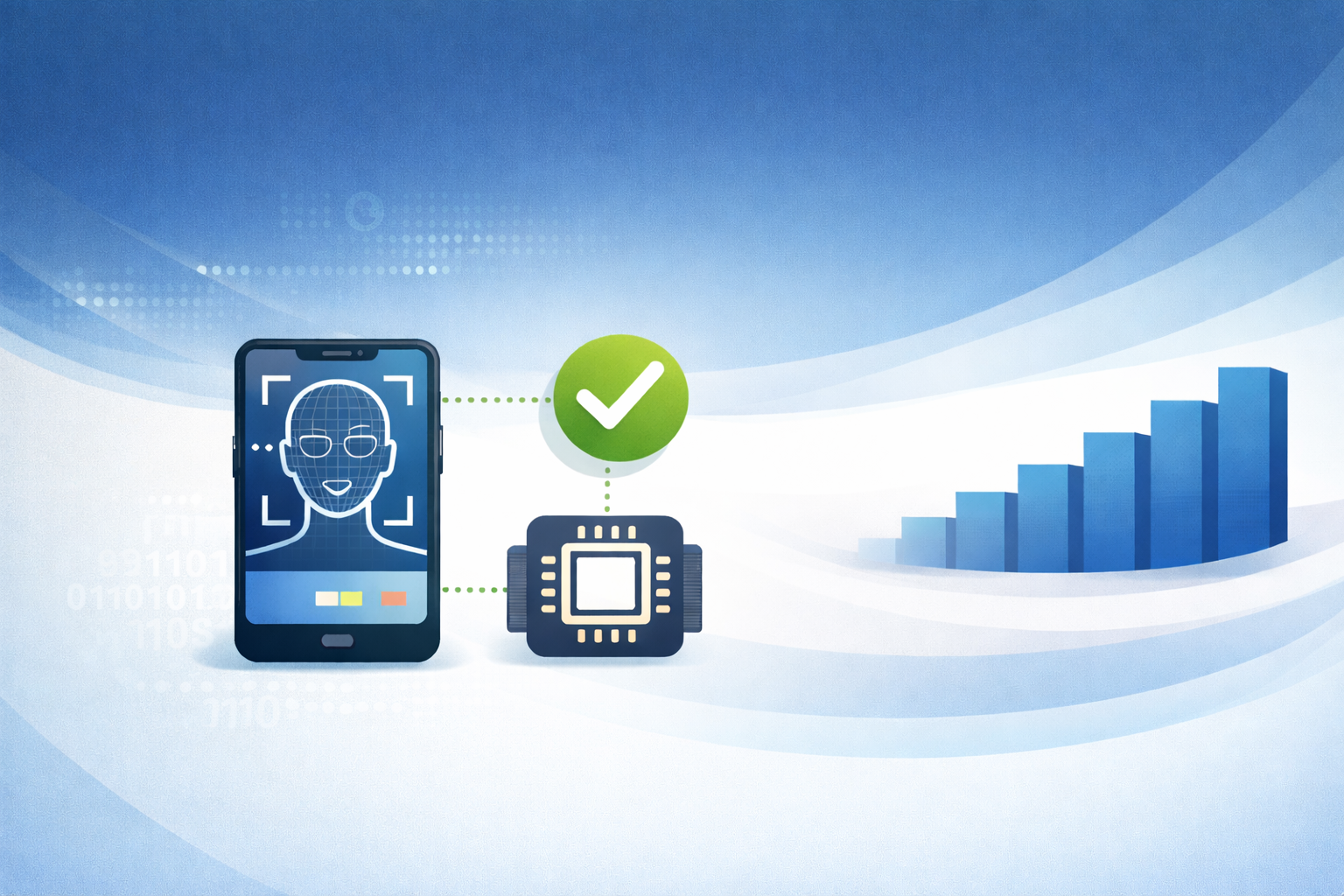
Privately SA has achieved standout performance in the latest testing by the US National Institute of Standards and Technology (NIST), reinforcing its position as a global leader in privacy-preserving age estimation.
In NIST’s large-scale evaluation of developer-submitted age estimation algorithms, Privately’s model delivered:
Competitive accuracy on young children
- 2.01 years Mean Absolute Error ages 0-17 (Visa dataset)
- 2.69 years Mean Absolute Error ages 0-30 (Visa dataset)
Enables real-time on-device deployment
- 64 millisecond inference time
- Tiny SDK footprint that is 20x-30x smaller than many competitors
Child safety performance for challenge 25 (application dataset)
- 3.95% False Positive Rate (FPR) for ages 14–17, calculated as the average FPR across both sexes within this age group.
- 6.1% False Positive Rate (FPR) for age 17, computed as the average of 12 FPR estimates across two sexes and six regions of birth
Because we run our models fully on-device – meaning we do not send biometric data to the cloud - this level of accuracy is significant. In fact, our performance is likely to be even better, as our live product uses multiple image frames, not just one image.
Unlike many solutions tested under NIST’s single-image conditions, Privately’s technology analyses video signals in real time, enabling stronger real-world performance while maintaining strict privacy guarantees.
What is NIST?
The National Institute of Standards and Technology is a US federal science agency responsible for developing standards and conducting independent evaluations across emerging technologies.
In the context of Age Estimation and Verification (AEV), NIST:
- Conducts large-scale, unbiased testing
- Benchmarks accuracy using millions of images
- Measures demographic performance and bias
- Publishes comparative results across vendors
NIST does not endorse vendors. Instead, it provides transparent, objective performance benchmarks that regulators, enterprises, and developers rely on. In an industry where claims of ‘accuracy’ are common, NIST provides something rare: independent validation under controlled, standardised conditions.
Accuracy without compromising privacy
Privately’s approach is fundamentally different from traditional cloud-based biometric providers. Instead of capturing an image and transmitting it to remote servers for analysis, Privately:
- Downloads a lightweight machine learning model (sub-2 0MB) to the user’s browser
- Performs the entire age assessment on the device
- Returns only a mathematical vector, not an image
- Stores no facial data centrally
- No personal identifiable information ever leaves the device
This architecture eliminates one of the biggest concerns in age verification: where biometric data goes, and who has access to it.
It also reflects a wider industry shift toward privacy-first infrastructure, particularly as regulators and platforms demand stronger safeguards.
Setting the standard for the future of age checks
NIST performance matters not only because it validates accuracy, but also because it sets the baseline for trust.
With governments worldwide introducing stricter online safety laws, platforms need solutions that are:
- Accurate
- Bias-aware
- Independently benchmarked
- Privacy-preserving
Privately’s strong NIST showing demonstrates that high accuracy and privacy are not trade-offs and that they can coexist.
And as on-device processing becomes the new standard for responsible biometric use, NIST validation offers enterprises and regulators confidence that the technology works, even under the most constrained testing conditions.